Table of Contents
Abstract
This invention is a windshield type that compensates for the radial optical effect that has a detrimental action upon human attention span for the purpose of designing better displays for all vehicle types from fast cars to planes that could benefit from a dynamic compensatory correction of the vantage point during driving. We suggest a convex semi-opaque mirror design that helps correct the radial optic-flow coined by perceptual psychologist James J. Gibson in the 1940s along with a small additional device to correct for Doppler effects during high velocity travel. The idea is drawn from fixing the “warp speed” display from TV shows like Star Trek, even though, we have determined that its applicability hinges on the same principles that apply even at sub-relativistic speeds such that cars or planes could correct the view in order to provide the driver or pilor with an 'augmented reality“ display that corrects errors in perspective traceable to principles of optics in physics. Whilst the design of the Doppler compensator is a pure colorimetry arithmetical shift of colors and hence cheap computationally, the variable opacity mirror just requires some liquid crystal blocking of light in the right proportions as distributed radially from the focal point and relative to the speed of travel which due to the design is still a computationally cheap operation while liquid crytal response times are well under the speed variations or acceleration of man-operated vehicles such as cars or planes.
Origin
This work was carried out due to the study of "that old familiar place", namely location-driven causality that would have it that some constructs are more common than other due to perpetual historical refinements that found an optimal architectural disposition of elements of infrastructure like buildings or roads.
It was observed that 90-degree crossroad junctions seem dangerous producing more and more accidents compared to European roundabout architecture that has the effect of increasing safety due to what was assumed to be perceptual issues consisting in the driver or pilot being able to discern the environment for both hard-angle and curbed roundabouts.
Similar to a roundabout that has this property of bending architecture in a “concave way” such that a driver not only does not have to turn their head a full 90 degrees to the left or right to observe traffic, the roundabout reduces the angle of observation to a sub-90 degree angle where the driver just has to look in front.
We thought it would be interesting that the implicit and perhaps undesired effect of alleviating the effects of the radial optic flow coined by perceptual psychologist James J. Gibson in the 1940s that the roundabout has could be ported into the domain of technology of engineering by modifying a windshield or a cockpit window using a convex mirror with computer-controlled variable transparency that would then correct the radial optical effect in order to provide the driver or pilot with a more accurate view of reality at any velocity that the vehicle can achieve.
The ultimate application is consumer-grade vehicles such as personal transportation vehicles in order to reduce the number of accidents caused by imperceptible warping effects that act on the attention span of drivers at high speeds but it seems clear that the same application might be useful at far larger speeds such as planes or even spaceships that travel at high velocities. The reason therefore is that this engineering is clamped to the limitations of human beings and not really a compensation for universal invariant, in the sense that this invention would be useless regardless the context provided that the driver or pilot of the craft is human and hence suffers the attention span decline due to the radial optical effect.
Radial Optic Flow vs. Linear Geometry

James J. Gibson in 1940s came up with the perceptual observation being a psychologist himself and the actual invention we propose uses optics to fix the distortion whilst Albert Einstein's theory of relativity inspire TV shows like Star Trek that depict not only “moving static objects” but light itself due to the extreme velocities, but we actually suggest that this problem pertains less to “physics” and is actually very simply illustrated using basic linear geometry.
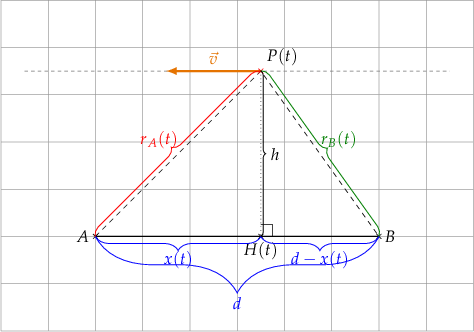
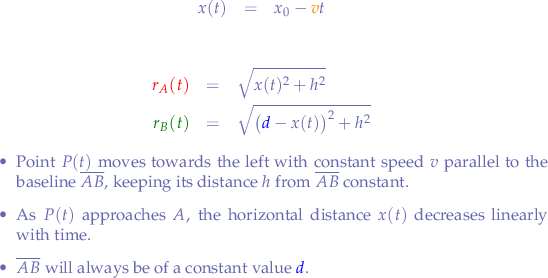
If you remember the Story of Achilles from the legistic section, Achilles never catches up with the tortoise he is racing against because mathematically he will always travel only a fraction of a distance towards the tortoise.
Compared to the story, the realities here are similarly based on a few mathematical properties that seem paradoxical given their practical application. Namely, it can be observed that the driver or pilot's  gaze into the distance
 will always be the same length regardless how the system moves on the outside - that is, the segment
 will remain the same for a driver or pilot that has not reached their destination yet with the actual distance
 being tailored to some notion of the curvature of the Earth and the eyesight of the pilot.
By contrast a point  to the left (or right) of the driver or pilot is actually an observably mobile point that moves towards the driver that compared to the ephemeral point in the distance is actually moving given the perception of the driver. The invention that uses a mirror to compensate actually notices that these observations are not discrete and that the entire field of view is actually a velocity map where objects that are closer to the edge travel faster than objects that are up-front such that the variable opacity of the mirror compensates for this velocity. Sure, as it was mentioned, the fix is to use some optical device but to be fair this is actually a “mechanical” problem and far from relativistic issues that reason within a context of exaggerated speeds.
Note that due to the former, this is not actually a problem of “magic” but rather a problem that derives from the assumptions and expectations of the system. A driver that looks forward can fix their gaze on some object and then immediately corrects their view as the object then gets closer to the driver in order to reset their view on yet another point in the distance hence maintaining the same distance as described by the line-segment . Clearly, objects in the distance move “even if they are static” but it is just that the driver has not reached their destination yet such that they do not care nor focus on objects that are getting closer and passing the driver.

The “dark-pattern” deception only becomes relevant when the driver has to pay attention to anything less than the forward ephemeral and resetting focal point in the distance when the driver stops observing “continuity” and starts observing actual kinetic fluctuations. This invention was derived from studying the US-based crossroad intersections that have sharp 90-degree angles, initially deemed to be the most optimal solution because it only required turing the head to the left and right instead of more than that and also looking behind, which is then succeeded by the newly implemented European roundabout that slims down the required angle of attention (amongst requiring less maintenance).
Now, we judge that the 90-degree crossroad intersection is absolutely brutally bad in terms of visibility, especially if there is overgrowth or other landmarks between the crossing lanes, but even abstracting away from the fauna, flora and man-made buildings, it was still determined that it takes about  for a driver to check both the left and right in order to ensure that there is no car coming transversely. It was similarly then deemed based on that that these US 90-degree crossroad intersections are really only suitable for craft traveling at up to
 such as a moped and even a typical sedan car is over the safety design limit of the 90-degree crossroad intersection. To the tune of “that old familiar place” we have already gathered data that justifies [our fractal universe with co-located manifolds] the fact that if you watch “road incidents” recorded in the USA, chances are that they are filmed by dashcams at these 90-degree crossroad intersection points rather than somewhere out in the open.

What we would wager that James J. Gibson with his Radial Optic Flow observation did not really spell out, is this magic-derived issue of human beings being implicitly affected by this warping effect. What happens is that we took a bit of a runaround, to borrow and expression, and “fixed the Star Trek bridge view” but even at sub-relativistic speeds this “warping” effect takes place implicitly. Whilst the “warping effect” is not as present or pronounced like “warp speed” or over-light speed in Star Trek, the principle that it is based upon happens at Newtonian speeds and according to us is more of a problem of pure geometry rather than physics such that this warping effect will always affect the driver or pilot and their attention span. Having to turn your head at a speed of  leaves you about
 to ensure nobody is coming from the left or the right, whilst at horse-drawn carriage speeds you have plenty of time, over
 to check and hence also the same amount of time to react in order to avoid a collision, with the difference being very large.
Historically, these 90-degree crossroad junctions never ever envisaged a world where even regular Sedans would travel at  speeds, such that even if well-maintained, these sharp angle intersections were really only tailored to the needs of the moment and what would have been technically feasible for the near-distant future. Using our invention, we manage, for example, to push the safe speed of the very same car from to
 at such a 90-degree intersection just by swapping out the windshield for our radial optic flow compensating windshield. However, overall the optic flow compensating windshield is not a solution for 90-degree crossroad intersections but it is a far broader compensatory for any sort of vehicle that observes a geometric warp just due to its own velocity. You could include fast cars or planes; maybe even if you drop-down to horse-drawn carriage this invention would still help at its extreme benefit due to correcting the very edge peripheral view that will always end up distorted relative to the central focal point. Clearly, the solution here is to use roundabouts that narrow the attention span requirement to a smaller and tighter angle within a closer vicinity of the focal point.
 Hey, it's exactly our invention but instead of modifying the car, it modifies the other cars!
Of course, the roundabout is more efficient from many-more points of view such that one would not really want to modify the car itself, however infrastructural changes are often costly, take time and ultimately this invention is applicable to any type of moving craft because it is not bound in just the context of sharp 90-degree angle crossroad intersections. Compared to hard-sciences and even implemented sciences like engineering, the human body is a biomechanical engine that is prone to failure from multiple factors such that reducing its reliance on intuition is always a net benefit if your intent is to reduce judgement of errors. In a non-warped parallax where the entire scene looks flat, a human being does not have to use higher brain function to “guesstimate” the location of objects relative to their distorted geometry, just like regular humans do when they drive by looking at the ripples or “feeling” the cars in traffic around them.
Some of the same radial optic warp takes place even in computer games, in particular, competitive first-person shooter (FPS) games where players that train by playing all the time are able to accurately “predict” the location of a different player just by knowing the environment really well that also includes this warped geometry around them. Players more then often use an increased field of view - or commonly known a “fish cam”, because by increasing the field of and squeeze more of the environment around them in plain sight at the cost of higher warping of the peripheral vision (that the player then has to compensate for and guesstimate with more complex brain functions). There are videos online that discuss what the optimal FOV would be for an FPS but ultimately this is a tradeoff that is strictly tailored to the player in terms of how much extra computation they are comfortable with doing vs. the amount of the environment in view whilst still remaining competitive within the game.
Our invention that applies to windshields would de-FOV the scene and obtain a Panini projection, with the video above by MMqd (the same author of the video explaining Panini has another nice video explaining planar mappings that produce a similar warping effect but statically) providing a pretty accurate view of what this windshield correction would look like within a computer game, because human vision has a fixed resolution and hence the only possible error correction that can be applied would be through an optical filter that manages to “decompress” the scene by fitting the same amount of the scene but then also correcting the warping effect. Compared to just a Panini filter, our invention is adaptive such that it will maintain the warping rate, namely what we consider to be a generator of perceptual errors, constant relative to the speed that the vehicle is traveling. That is, the mirror would adjust its radial opacity according to the speed of travel in order to de-warp less or more towards higher velocities thereby achieving an “augmented reality” (or corrected reality) where the driver or pilot will be able to observe the full and complete scene all the time without any geometric distortion. Given how much people drive, humans already adapted to the perspective error created by velocity and even train themselves to live with this paradox of nature, such that it might be funny watching someone drive a car with this invention in place because they would require much less concentration to drive given that they would be able to assess the whole scene statically instead of using their brain along with the warping effect to evaluate the scene dynamically. One look at the windshield and a driver would instantaneously know where everything is placed without having to carry on doing tertiary brain operations to figure out “where things really are” when compensating for the distortion.
Practical Implementation

Albeit mentioned in the archeometry section whence the invention is inspired from, we would wager that the radial optic flow compensator is a device that only hinges on linear computer arithmetic that can be carried out even directly within registers. The Doppler-compensator is a bit of a gimmick at sub-light speed such that it is less practical in terms of color distortions but even this gimmick would be a purely digital device that does not require any advanced floating-point processing such as computations pertaining to geometry that would make the invention computational heavy. The optic flow compensator, which is the central part of this invention, just needs to adjust the opacity of an existing mirror using some simple arithmetic that is clamped to the speed of travel in order to compensate for the parallax distortion effect. Otherwise, the heavy lifting is actually performed by the architectural design of a mirror interposed along the line of the viewport that has the effect of undistorting the peripheral view. On the matter of the Doppler correction being a gimmick, it seems clear that even with fast race-cars objects or lights will not shift in phase, hence distorting the observer vantage point, however the principle could then rather fix the sound or audio if the driver listens to the road by computationally compensating for the sound-travel distance and then providing accurate non-distorted feedback to the driver.
With that said, the cost to benefit ratio should not be that high, given that the mirror is highly static and all the computations necessary for shading the mirror consists in solving a single linear equation by plugging in the velocity whilst knowing the curvature of the windshield and having all other parameters stored in memory as fixed constants that do not need runtime re-evaluation.
Publication Link
Known-Literature Confirmation of Invention

Technical Paper